
Austin’s market has flipped. There were about 12,500 homes for sale across the metro this spring, roughly 4.7 months of inventory, and the average listing now sits around 61 days before it sells. The metro median is hovering near $450,000, close to flat year over year. Buyers have time to be picky, and they’re using it.
We get the same question all the time from homeowners thinking about selling. Which projects are worth doing, and which ones are money they’ll never see again. Most of the “best ROI” lists online answer that with national averages and stop there. They skip the parts that bite you in Austin. Permits that take weeks. A remodel that bumps your Travis County appraisal. Clay soil that moves your foundation the same year you drop $30,000 on a kitchen.
Below are the projects that pay off here, the ones that don’t, and the local details that decide which is which. The return numbers come from Zonda’s 2025 Cost vs. Value Report. The Austin context comes from doing this work for 20 years.
Start With the Garage Door
This one surprises people every time. Garage door replacement tops the Cost vs. Value report again for 2025, recouping about 268% of its cost at resale. You spend somewhere around $4,700 and it reads as more than double that in perceived value.
The cost is low and the change is the first thing anyone sees from the street. A faded, dented door tells a buyer the house wasn’t kept up, and they start looking for other things. A clean new door shuts that thought down before it starts.
Get a steel-insulated door, not a bare panel. It holds up better through Austin’s heat cycles, and it cuts the heat coming off an attached garage into the rooms next to it. That matters here more than it does up north.
Fix the Front Door and the Yard
A new steel entry door recoups around 216% at resale, second only to the garage door on the national list. Pair it with the landscaping and you’ve built the cheapest exterior refresh there is, no full renovation required.
Landscaping earns its keep in Central Texas, and native plants are the way to do it. Austin Water has been running Stage 2 restrictions most summers, which means one watering day a week. A yard full of thirsty turf looks rough by August and signals a water bill the buyer will inherit. Texas sage, agave, lantana, and black-eyed Susans hold their color on almost no water. Limestone edging and flagstone paths read local and hold up in clay soil where wood borders rot and shift.
On a tighter budget, a repainted front door, new house numbers, and a pressure-washed driveway change the first impression for a couple hundred dollars.
Do the Small Kitchen, Not the Big One
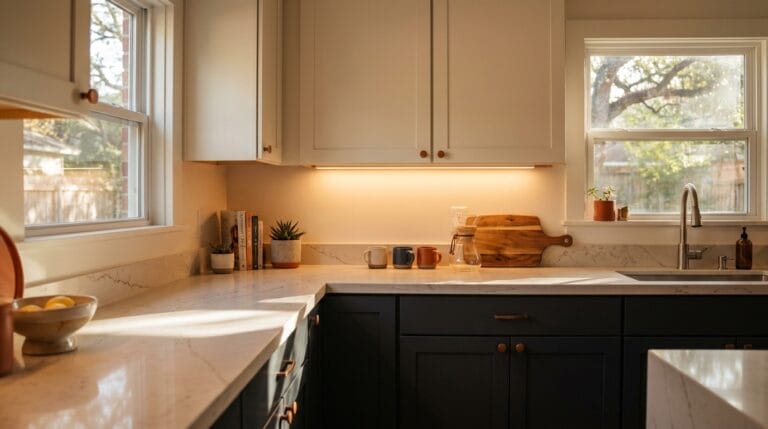
Here’s where homeowners talk themselves into trouble. A full kitchen gut recoups about 51% of its cost. A minor kitchen remodel that updates surfaces and fixtures without moving walls recoups around 113%. That’s the difference between losing half your money and getting all of it back.
The minor version means new cabinet fronts or refinished boxes, updated hardware, fresh counters, and better lighting. You skip the expensive part, which is moving plumbing, rerouting electrical, and buying all-new cabinets. Quartz counters are the one to get. They shrug off heat, need no sealing, and take daily use better than marble or a low-grade granite.
Lighting is the upgrade people undervalue. Under-cabinet LED strips, a couple of pendants over the island, and recessed cans in place of an old surface fixture make a mid-range kitchen feel a tier higher. Buyers notice a bright kitchen even when they can’t say why.
One note on backsplash. Subway tile still works, but Austin buyers have seen it in every listing for a decade. A larger-format tile in a neutral tone reads current without chasing a trend that dates in three years.
Update the Bathroom to Mid-Range
A mid-range bathroom remodel recoups about 80% of its cost. Push it into spa territory with heated floors, a freestanding soaker, and custom tile work, and the return drops toward half. You spend a lot more and get a lot less back.
What moves a bathroom is a new vanity with drawers instead of a pedestal, better vanity lighting, water-saving fixtures, and fresh tile if the old tile is cracked or stained. Don’t skip the exhaust fan. Austin humidity grows mold behind walls in homes that feel bone dry, and a fan sized to the room’s square footage is the kind of thing an inspector notes and a buyer remembers.
If you’ve got an older home with one bathroom, adding a second one, even a half bath carved out of a closet or utility room, adds more than renovating the bath you have. Buyer expectations on bathroom count have moved here.
Replace Single-Pane Windows
Window replacement recoups about 76% at resale. That looks weak next to the garage door, but the resale number undersells it in a climate where the AC runs from May into October.
Single-pane windows make your system work harder every hot afternoon. Energy-efficient units can cut cooling costs 10 to 25% depending on what you’re replacing and which way the house faces. On a July electric bill, that shows up as money the new owner keeps saving.
Spec them for Texas heat, not a catalog. Look for Low-E glass with a Solar Heat Gain Coefficient between 0.20 and 0.30. Double-pane with argon fill is the standard that makes sense here. Triple-pane costs 15 to 50% more, and in a warm climate the extra savings take 15 to 20 years to pay back the difference. Vinyl frames are the value pick and handle the heat well. Fiberglass lasts longer and costs more up front. Wood looks the best and needs the most upkeep through our swings and the occasional freeze.
Don’t Forget the AC
HVAC gets left off most value lists because you can’t see it. In Texas that’s a mistake.
A system that’s 12 years or older becomes a negotiating point whether you bring it up or not. Buyers know a Texas AC works hard, and they’ll price a replacement into their offer. Quotes have climbed fast, too. A unit that ran $13,000 a couple of years ago is closer to $16,000 now, so the number a buyer subtracts keeps getting bigger.
If you’re replacing it, look for a SEER2 rating above 16. That’s the efficiency tier that matters over a long cooling season, and it’s a specific selling point for anyone watching their summer bills. Replacing it before you list gets ahead of a conversation you’d otherwise have on the buyer’s terms.
The Austin-Specific Stuff the National Lists Skip
Every ROI article covers the projects above. Almost none of them cover what those projects trigger here, and this is where Austin homeowners get caught.
Your property taxes. Travis County caps the taxable value of a homestead at 10% growth a year, which sounds like protection. The catch is that new improvements get added on top of the cap. A cosmetic refresh that doesn’t need a permit stays under it. A permitted addition, a new bathroom that adds square footage, or a pool gets appraised as new value and raises your bill directly. Factor that into anything that grows the footprint.
Permits and the timeline. The City of Austin aims to turn most residential permits in about 10 business days, but reviewers routinely come back with revisions, and bigger projects run weeks to months. Plan the schedule around that, not around a best case. Unpermitted work is worse than slow work. When you sell, a buyer’s agent can and will subtract the “value” of anything done without a permit as a negotiating move, and lenders and inspectors look for it.
Your foundation. East of I-35 sits on expansive clay that swells when it’s wet and shrinks in a drought, and it moves slabs. It’s the first thing a lot of Austin buyers ask about, ahead of the kitchen. If you’ve got cracks that keep coming back, address the drainage and grading before you spend on finishes. A new kitchen over a moving foundation doesn’t sell.
Solar, if you have it. Owned panels can add value. Leased panels routinely stall Austin deals, because the buyer has to qualify to assume the lease or you have to buy it out at closing. If the panels aren’t paid off, know where you stand before you list.
The Mistake That Costs the Most
Over-improving for the block. Drop a $60,000 kitchen onto a street where homes top out at $380,000 and you don’t get that back. Comparable sales set your ceiling, not the quality of your finishes. Before you commit to a big project, look at what nearby homes sold for and work backward from that number.
All of it comes back to the same point. Austin buyers right now have time on their side and plenty of listings to compare yours against. The homes that hold their value are the ones where the mechanicals are solid and the visible updates hold up. Spend there first.
Want to talk through which of these makes sense for your home? Call us at (512) 761-7336 or reach out online for a free estimate. We handle kitchen and bathroom remodels, along with the smaller upgrades on this list, across Austin and the surrounding area.
Frequently Asked Questions
If I can only do one project before selling, which one?
Start with whatever a buyer or inspector flags first, not the prettiest upgrade. Walk your house like a stranger sees it. Is the AC over 12 years old? Are the windows fogged between the panes? Is the garage door dented and faded? Fix the things that create doubt before you spend on the ones that look nice.
Does the order I do projects in matter?
Yes. Do the mechanical and structural work first, meaning roof, HVAC, windows, and plumbing, then the cosmetic finishes. Finishing a bathroom and then opening a wall for a plumbing fix you knew about is money spent twice.
Will remodeling raise my property taxes in Travis County?
It can. Your homestead’s taxable value is capped at 10% growth a year, but new improvements get added on top of that cap. Cosmetic work that doesn’t need a permit generally stays under it. A permitted addition, extra square footage, or a pool gets appraised as new value and raises your bill. Budget for the higher tax, not just the construction cost.
Do these projects need a permit in Austin?
Most cosmetic work like paint, cabinet fronts, and fixtures doesn’t. Structural changes, electrical panel upgrades, window swaps that alter the opening, and HVAC replacements usually do. Skipping a required permit to save time backfires at resale, when a buyer’s lender or inspector finds it and the price gets renegotiated.
How much should I spend before selling?
A working rule is no more than 10 to 15% of the home’s current value on pre-sale improvements. On a $450,000 Austin home that’s roughly $45,000 to $67,000. Past that, you’re unlikely to earn it back in the sale price, and comparable sales on your street cap what you can list for.
Does it matter that Austin is a buyer’s market right now?
It changes the strategy. When buyers have the upper hand, deferred maintenance kills a deal faster than dated finishes do. Put your money into the functional stuff, meaning HVAC, roof condition, and windows, over style-driven upgrades that a buyer might redo anyway.
How do I find a contractor I can trust?
Ask for a license number and verify it through the Texas Department of Licensing and Regulation. Confirm they carry insurance. Get at least two itemized bids and read the line items, not just the total. Be skeptical of a bid that comes in far under the others. Material and labor costs are steady enough here that a rock-bottom number usually means something got left out.
Planning a Renovation?
Tell us what you're working with and what you want it to be. We'll walk the space, scope the work, and give you a clear estimate.
Or call us at (512) 761-7336