Most Austin kitchens weren’t built for how people actually cook today. The standard layout from the 1980s or 1990s assumed one person, one task at a time. If your kitchen feels like it’s working against you, the problem is usually layout and systems, not a lack of square footage.
These upgrades address the real friction points. They’re organized by impact, not cost.
Start with Layout Logic, Not Aesthetics
Before spending money on finishes, it’s worth understanding why your kitchen may feel inefficient.
For decades, kitchen design relied on the work triangle, a concept developed in the 1940s that connects the sink, refrigerator, and cooktop. Each leg should be 4-9 feet, with the total triangle perimeter between 13 and 26 feet. It still works well for smaller, single-cook kitchens. But if you have a larger kitchen, an open-concept layout, or multiple people cooking at once, the triangle falls apart.
The more useful modern approach is work zones. Instead of appliance positions, you organize your kitchen around specific tasks. Common zones include prep, cooking, cleaning, storage, and a dedicated serving area. A coffee station separate from the main prep zone, a baking area with counter space and below-counter storage, or an island sink that handles cleaning while the perimeter cooktop handles cooking. These all reflect how people actually move through a kitchen.
Before any physical work, sketch your zones and see where you’re forcing unnecessary movement. That single insight often determines which upgrades are worth doing.
Storage — The Problem Is Usually the Cabinet, Not the Count
Most Austin kitchens have adequate cabinet space on paper. The issue is that standard shelved base cabinets are one of the worst storage systems ever designed. You can only access what’s in front, which means everything in the back gets lost or ignored.
Pull-out shelves and full-extension drawer inserts inside base cabinets solve this immediately. They make every inch of a cabinet accessible without kneeling, reaching, or unstacking. For corner cabinets, a chronic dead-zone in most layouts, pull-out organizers or a well-fitted lazy Susan retrieve space that is otherwise wasted.
Two practical upgrades worth prioritizing.
- Replace at least your lower base cabinet shelves with pull-out drawers, especially for pots, pans, and pantry staples
- Add a dedicated pantry pull-out if you have an underused narrow cabinet (even a 9-inch pull-out can hold more than a standard 24-inch base cabinet used inefficiently)
Adding a pantry space, whether through a reach-in update or a small walk-in conversion, carries up to 70% ROI and is a consistent buyer talking point. It also reduces countertop clutter, which makes the whole kitchen feel larger without touching the layout.
Lighting — The Spec Details That Most Guides Skip
Better lighting makes more difference in a kitchen than most homeowners expect. Most kitchens are dramatically under-lit, especially at the counter.
Under-cabinet task lighting should hit 250-450 lumens per linear foot of cabinet run. Mount the strip at the front rail of the upper cabinet, not the back, to eliminate backsplash shadows on your counter. Puck lights are not the right tool here. They create spotty “scallop” patterns and uneven illumination. Use continuous LED strip or rigid bar lighting instead.
Color temperature matters. Keep all your task lighting at the same Kelvin rating. Don’t mix warm 2700K under-cabinet lights with cool 4000K overhead cans. For most Austin kitchens with warm wood tones, natural stone, or earthy finishes, 3000K is the most flattering and practical choice.
Layered lighting is what separates a functional kitchen from a well-designed one. Recessed LED cans for ambient, under-cabinet strips for task, and pendant fixtures over an island for accent and atmosphere. A dimmer on the pendants and accent lights extends the room’s versatility from meal prep to dinner.
Ventilation — The Most Overlooked Functional Upgrade
Range hoods are one of the most functional upgrades a kitchen can get, and almost no one sizes them correctly.
CFM (cubic feet per minute) is the ventilation rating that determines whether your hood actually clears smoke, steam, and cooking odors or just moves warm air around.
How to size it.
- Gas range: Add up the total BTUs across all burners. Use 1 CFM per 100 BTUs. A standard gas range running 40,000 total BTUs needs at least 400 CFM.
- Electric or induction cooktop: Use 100 CFM per linear foot of cooktop width for a wall-mounted hood. A standard 30-inch cooktop needs at least 250 CFM.
- Island hoods require more, roughly 150 CFM per linear foot, because they lack a wall to assist capture.
An undersized hood is one reason Austin kitchens trap heat in summer. If your HVAC seems to struggle in the kitchen specifically, an undersized or recirculating hood (one that filters and recycles air rather than venting outside) is often part of the problem. Ducted to the exterior is always the better option.
Cabinets — Refinish or Reface Before You Replace
A full cabinet replacement is one of the highest-cost, lowest-ROI moves you can make in a kitchen. A minor kitchen remodel, updating surfaces and systems without structural changes, returns 96-113% of its cost at resale. A major kitchen remodel returns 38-51%. The difference between those two numbers is often the cabinet decision.
If your cabinet boxes are structurally solid (no soft spots, no moisture damage, no warping), refacing (replacing the doors, drawer fronts, and hardware while keeping the boxes) is a fraction of the cost of new cabinetry and produces a comparable visual result.
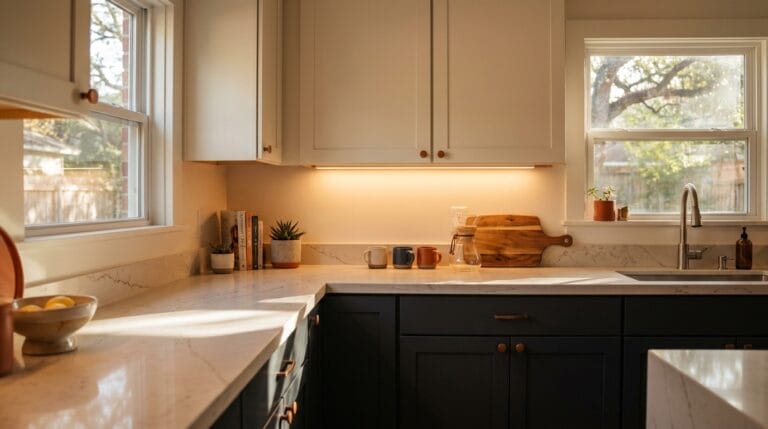
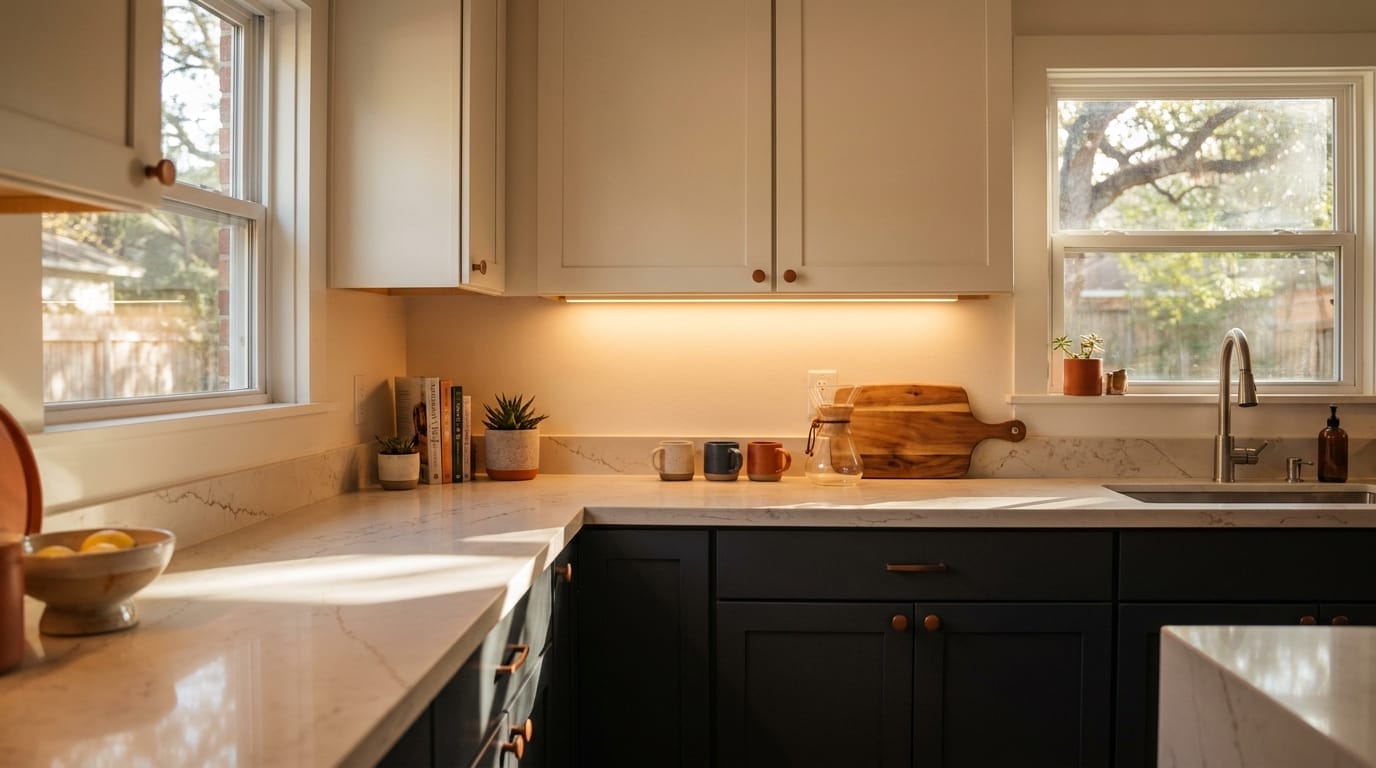
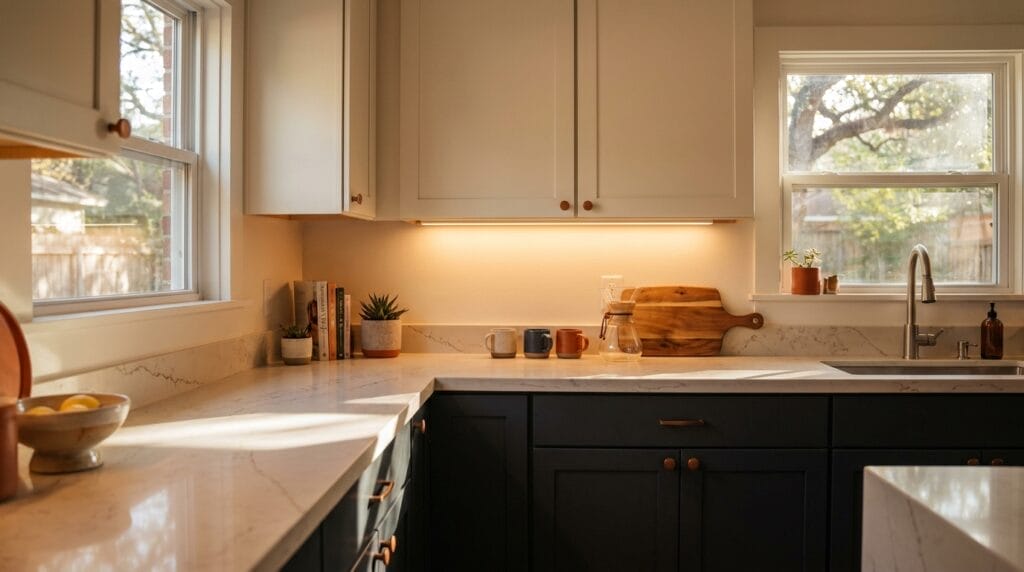
In Austin right now, the all-white kitchen is giving way to two-tone designs. Lighter upper cabinets paired with a deeper lower color. Navy, charcoal, deep green, or warm greige. Flat-front door profiles read as contemporary and work well with the warm, earthy palette Austin homeowners are moving toward.
Hardware is a low-cost, high-impact change. Swapping pulls and knobs is one of the few kitchen changes that takes an afternoon, costs $200-$500 for a full kitchen, and visually shifts the entire room.
Countertops — Quartz vs. the Alternatives
Quartz is still the practical standard for most Austin kitchens. It doesn’t require sealing, handles heat reasonably well, and holds up under daily use without the maintenance cycle of natural stone. For resale, it’s a known quantity that buyers recognize.
Where quartz falls short. It can look generic in a kitchen that’s trying to have character. Quartzite (natural stone, not to be confused with engineered quartz) offers more variation and visual depth, though it requires periodic sealing. Butcher block sections, used on an island or prep zone rather than around the sink, add warmth and function. They’re also repairable in a way stone countertops aren’t.
If budget is the constraint, countertop replacement is a better investment than cabinet replacement. New counters with refinished cabinets and updated hardware will outperform the reverse combination in both appearance and ROI.
Appliances — What Actually Matters
Two things matter when upgrading kitchen appliances. Energy efficiency and fit.
Counter-depth refrigerators align with the cabinet face rather than protruding into the walkway. In any kitchen under 200 square feet, a standard-depth refrigerator blocking a traffic path is a real functional problem. Counter-depth models cost more but recover that premium quickly in livability.
ENERGY STAR-certified appliances reduce energy costs and are an increasingly specific buyer request in Austin, where utility bills are a real concern given long cooling seasons. Certified dishwashers and refrigerators use substantially less energy than decade-old units.
Induction cooktops are worth calling out specifically for Austin. They generate less ambient heat than gas burners, which is meaningful when your kitchen is already fighting summer temperatures. They heat faster and more precisely. The tradeoff is that they require compatible cookware. Cast iron and stainless steel work. Copper and aluminum don’t without an induction disk.
The Budget Priority Order
If you’re working through this sequentially.
- Storage systems – highest daily impact, lowest cost
- Lighting – task and ambient, properly spec’d
- Ventilation – if undersized or recirculating
- Cabinet refinish/reface + hardware – high visual return, mid cost
- Countertops – durable, buyer-friendly
- Appliances – as needed or at end-of-life
A full gut renovation almost never returns what it costs. Targeted upgrades that address real friction points do.
Want to talk through what makes sense for your kitchen? Call us at (512) 761-7336 or reach out online. We handle kitchen remodels across Austin and give straight answers on what’s worth doing.
Frequently Asked Questions
What’s the difference between refacing and refinishing cabinets?
Refinishing means stripping and repainting or restaining the existing doors and boxes. Refacing means replacing the door and drawer fronts entirely while keeping the boxes. Refinishing is cheaper ($1,500-$4,000 for a full kitchen) but only works if the door style is worth keeping. Refacing ($4,000-$12,000) is the better option if you want a different door style or the finish is beyond saving. Neither makes sense if the cabinet boxes are structurally compromised.
Is induction cooking better than gas for an Austin home?
For most Austin homes, yes. Induction generates significantly less ambient heat than gas, which matters in a kitchen running AC from May through October. It heats faster and with more precision. The tradeoff is that you need induction-compatible cookware (cast iron, magnetic stainless steel), and the upfront cost is higher. Most people who switch don’t go back.
How do I know if my range hood is actually working?
Hold a piece of tissue near the hood while the fan runs on high. It should pull firmly and hold. If it flutters weakly or you still smell cooking odors an hour later, your hood is either undersized, needs cleaning, or is recirculating rather than venting outside. A recirculating hood filters and returns air to the kitchen. It doesn’t remove heat or moisture.
What kitchen upgrades do Austin buyers notice right now?
In the current buyer’s market, buyers are scrutinizing function more than finishes. Updated storage systems (pull-outs, organized pantry), good task lighting, and modern appliances get noticed. All-white kitchens read as dated to many buyers. Two-tone cabinets, warm natural finishes, and earthy-toned countertops are trending locally. The bigger flag for buyers is a kitchen that feels cramped or poorly lit, even if the finishes are new.
Can I add a kitchen island if my kitchen isn’t that large?
Yes, but size matters. An island needs at least 42 inches of clearance on all sides for a one-cook kitchen, and 48 inches if two people will use it at the same time. Below that, an island blocks traffic flow more than it helps. In tighter kitchens, a rolling cart or a peninsula (attached to the wall on one end) often solves the counter space problem without sacrificing movement.
How long do kitchen renovations take in Austin right now?
A minor remodel (cabinets, countertops, lighting, fixtures without layout changes) typically runs 2-4 weeks once materials are on hand. Lead times on cabinets, appliances, and countertops are where projects stall. Semi-custom cabinets can run 6-10 weeks out. A full remodel with layout changes, plumbing moves, or new electrical can run 6-12 weeks. The Austin contractor market has more availability than it did in 2021-2023, but materials lead times are still the primary scheduling variable.
Does a kitchen remodel require permits in Austin?
Cosmetic work (painting, cabinet refacing, new countertops, fixture swaps) does not. Electrical work (adding circuits, moving outlets, new lighting beyond simple fixture swaps), plumbing changes (moving the sink, adding a dishwasher line), and structural changes (removing walls, widening openings) all require City of Austin permits. Unpermitted work on plumbing or electrical is a common flag during home inspections and can complicate a sale.
What’s the one kitchen upgrade that makes the biggest daily difference?
Pull-out shelves in base cabinets. Eliminating the need to crouch, reach, and unstack to find something in the back of a lower cabinet changes how a kitchen feels to use every day. It’s one of the least expensive upgrades per cabinet run and one of the highest-impact in terms of daily friction removed. If budget is tight, start here.
Got a Project in Mind?
Tell us what you’re thinking — we’ll give you a straight answer and a free estimate. No pressure, no runaround.
Or call us at (512) 761-7336